What Do Crystal Meanings Actually Mean? Folklore, Symbolism & Science
What do crystal meanings such as love, protection and abundance actually refer to? Learn where crystal symbolism comes from, what is folklore and what mineral science can really tell us.
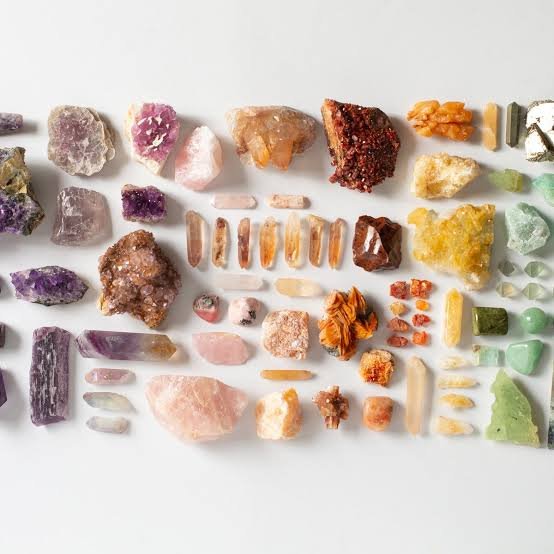
Search for almost any popular crystal online and you will quickly find a list of meanings attached to it. Rose quartz means love. Amethyst means calm. Citrine means abundance. Black tourmaline means protection. Fluorite means focus.
But what does it actually mean to say that a mineral has a “meaning”?
The short answer is that crystal meanings are symbolic associations, not physical properties of the mineral. They can come from historical folklore, religious traditions, astrology, colour symbolism, more recent spiritual practices or modern crystal culture. Some associations have genuine historical roots; others are surprisingly recent. None should be confused with the measurable mineralogical characteristics of the stone itself.
At Fans of Crystals, we think both sides can be interesting — as long as they are not mixed together.
For example, amethyst really is a purple variety of quartz. Its hardness, chemical composition and crystal structure can be measured. Its association with sobriety, clarity or calm belongs to a different category: history, folklore and contemporary symbolism. Understanding that distinction makes the world of crystals considerably more interesting.
The quick answer: what is a crystal “meaning”?
When someone asks for the “meaning” of amethyst, rose quartz or another crystal, they are usually asking about the ideas traditionally or popularly associated with that stone.
Depending on the mineral, those associations may come from:
- ancient or historical beliefs
- religious or ceremonial uses
- folklore
- astrology
- birthstone traditions
- colour symbolism
- jewellery traditions
- modern metaphysical practices
- contemporary crystal-healing culture
These are not the same thing as scientific mineral properties.
A mineral has characteristics such as chemical composition, hardness, crystal structure, cleavage, lustre and density. The U.S. Geological Survey defines a mineral in terms of its naturally occurring composition, orderly internal structure, crystal form and physical properties. “Love”, “protection” or “abundance” are not mineralogical properties in the same sense that Mohs hardness or chemical formula are.
That does not make symbolism meaningless. It simply means it belongs to a different kind of discussion.
Crystal meanings did not all come from one tradition
One of the misleading things about modern crystal charts is that they can make it seem as though humanity has always agreed that each stone possesses one fixed meaning.
History is much messier.
Gemstones and minerals have been used as objects of decoration, status, devotion, protection and symbolism across many cultures and time periods. The Victoria and Albert Museum notes that gems have carried beliefs about protective and healing powers for centuries, while medieval European “lapidaries” compiled ideas about the magical, astrological, religious and medicinal qualities of stones.
Those traditions were not universal.
A stone could have one significance in ancient Greece, another in medieval Europe, another in South Asia and yet another in modern New Age practice. Meanings also changed as beliefs, trade routes, fashions and religious ideas changed.
In Indian traditions, for example, gemstones have historically been connected with planets, deities and days of the week. The Metropolitan Museum of Art describes texts in which different gems carried astrological and cosmic significance.
That is quite different from a modern Pinterest graphic telling you that emerald simply means “abundance”.
Both may be described online as a “crystal meaning”, but they come from very different contexts.
Amethyst is a good example of how meanings evolve
Today, amethyst is commonly associated with calm, clarity and sleep.
Historically, however, one of its most famous associations was with sobriety.
GIA notes the long-standing Greek association between amethyst and Bacchus, the god of wine, and the belief that the stone could help prevent drunkenness.
The modern association with clear-headedness may feel related, but that does not mean there has been an uninterrupted 2,000-year tradition saying:
Amethyst = calm + sleep + anxiety relief.
Modern crystal culture often takes historical stories, colour associations and newer spiritual ideas and blends them into a simpler set of meanings.
That is why it is useful to ask where a claimed meaning actually comes from rather than assuming every crystal association is ancient.
The physical crystal and the symbolic crystal are two different things
Take amethyst again.
From a mineralogical perspective, amethyst is a purple variety of quartz. Quartz has the chemical formula SiO₂ and forms under particular geological conditions. Amethyst-bearing cavities and geodes can form in volcanic rocks, and the material belongs to an enormously important mineral family.
Those facts are testable.
You can examine a specimen’s:
chemical composition
hardness
crystal habit
fracture
inclusions
colour zoning
geological origin
Its symbolic meaning is different.
“Amethyst is traditionally associated with clarity” is a statement about culture or belief.
“Amethyst has a Mohs hardness of 7” is a statement about mineralogy.
The problem begins when those two categories are presented as though they carry the same kind of evidence.
Where modern crystal meanings often come from
Contemporary meanings usually appear to be the result of several traditions being layered together.
Historical folklore
Gemstones have accumulated myths for centuries.
Sapphire, for example, has historically been associated with royalty, faithfulness and protection. GIA documents beliefs ranging from heavenly blessings to protection from envy.
Lapis lazuli has an equally long symbolic history, alongside its practical history as a decorative stone and source of ultramarine pigment.
Religious and astrological traditions
Different cultures developed systems connecting stones with planets, gods, zodiac signs, religious symbolism or ritual practices.
These traditions should ideally be identified by culture and period rather than lumped together as universal “ancient wisdom”.
Birthstone traditions
Birthstones created another layer of association.
A gem can therefore come to represent a month, personality trait or sentiment even when that association has little to do with its geology.
Colour symbolism
Sometimes an association probably owes as much to appearance as anything else.
Pink stones are frequently connected with love. Green stones become associated with growth, prosperity or nature. Black stones are often described as protective or grounding.
That does not necessarily mean somebody thousands of years ago established an authoritative mineral-to-emotion system. Human beings naturally attach meanings to colours, materials and objects.
Modern metaphysical culture
A significant portion of the crystal vocabulary people encounter today is modern.
Terms such as “manifestation crystal”, “high-vibration stone”, “energy cleansing” and highly specific emotional or lifestyle benefits belong largely to contemporary metaphysical culture rather than mineralogy.
That does not automatically make these practices illegitimate as personal or spiritual traditions. It simply helps to identify what kind of claim is being made.
Are crystal meanings scientifically proven?
Symbolic meanings do not really need scientific proof in the first place.
You do not need a clinical trial to say that a wedding ring symbolises commitment or that a particular flower has traditionally represented remembrance. Symbolism exists because people give objects meaning.
The situation changes when a symbolic association becomes a claim that a crystal physically or medically causes an effect.
There is currently no good evidence that a particular crystal has a specific therapeutic effect simply because of the mineral itself. A recent controlled study comparing rose quartz with visually matched placebo stones found no specific anxiety-reducing effect attributable to the crystal; responses were associated instead with participants’ expectations and pre-existing beliefs.
That is why there is an important difference between:
Amethyst is commonly associated with calm in contemporary crystal traditions.
and:
Amethyst treats anxiety.
The first describes a tradition.
The second makes a health claim.
Fans of Crystals treats those as very different statements.
Does that mean crystal meanings are pointless?
Not necessarily.
People have always assigned meaning to objects.
A person may keep a particular mineral because it reminds them of someone, represents a goal, marks an important event or simply gives them a physical object around which to build a personal ritual.
Someone starting a new job might choose pyrite because prosperity is one of its popular modern associations. The mineral is not required to generate prosperity for the symbolism to matter to that person.
Similarly, rose quartz can function as a symbolic gift associated with affection without anyone needing to prove that quartz emits a measurable “love frequency”.
There is room between believing every metaphysical claim literally and insisting that objects cannot hold symbolic meaning at all.
Sometimes a crystal meaning tells you more about people than minerals
Minerals are geological materials formed through processes that took place independently of human beings.
Humans then found them. We noticed that some were unusually colourful, transparent, reflective or hard. We carved them, traded them, wore them, buried them with the dead, gave them to rulers, incorporated them into religious objects and eventually sold tiny polished versions of them on TikTok.
Over time, stories accumulated around the material. Museums contain countless examples of gems and minerals being used not merely because they were attractive, but because people believed the materials carried protection, status, religious significance or other symbolic properties.
In that sense, the history of crystal meanings is partly the history of what humans choose to project onto unusual things pulled from the ground.
Why meanings often contradict each other
Search three websites for the meaning of fluorite and you may receive three different answers.
One might call it a stone of focus.
Another says intuition.
Another says protection.
This should not be particularly surprising once you understand where these systems come from.
There is no scientific organisation assigning official meanings to minerals.
The International Mineralogical Association concerns itself with mineral species and nomenclature, not whether a mineral should symbolise confidence or creativity. Mineralogical classification depends on things such as chemical composition and atomic structure.
Symbolic traditions develop much less formally.
Different books, teachers, traditions, retailers and communities can therefore attribute different meanings to the same stone.
When you see:
Fluorite Meaning: Focus
it is better to read that as:
Fluorite is commonly associated with focus in some modern crystal traditions.
That wording is less dramatic, but considerably more accurate.
Are ancient crystal meanings more authentic?
Not automatically.
“Ancient” is one of the most overused words in crystal marketing.
A genuine historical belief can be fascinating, but its age does not make it scientifically true. It also does not necessarily mean the belief existed everywhere.
And sometimes claims described online as ancient have been simplified, reinterpreted or detached from their original cultural context.
A better question is:
Which culture?
Which time period?
What source records the belief?
Was the mineral even being identified by the same name at the time?
Historical gemstone terminology can itself be complicated. Names used centuries ago did not always correspond neatly to modern mineralogical classifications.
Good crystal history tends to become more interesting when it gets more specific, not less.
What about chakras and zodiac crystals?
These belong in the same broad category of symbolic or spiritual systems.
Astrological gemstone traditions have genuine historical precedents in several cultures. South Asian gemstone traditions, for example, include long-standing associations between particular gems and planetary influences.
But the neat modern lists you encounter online — one crystal for each zodiac sign, one stone for each chakra, one crystal for each life problem — may combine older ideas with much newer practices.
They should therefore be presented as traditions or belief systems, rather than as properties discovered through mineral science.
How Fans of Crystals presents crystal meanings
Our Crystal Library separates three things that are frequently mixed together elsewhere.
1. Mineral facts
These include measurable or observable information such as:
- mineral species
- chemical composition
- crystal system
- Mohs hardness
- lustre
- cleavage
- fracture
- formation
- locality
- known treatments
2. History and folklore
Here we can discuss documented historical uses, cultural associations, traditional beliefs and symbolism.
Where possible, those claims should be tied to a specific culture, period or source.
3. Contemporary crystal associations
These are the meanings commonly encountered in modern crystal culture.
They might include ideas such as love, protection, focus, abundance or confidence.
We describe them as associations, not scientifically demonstrated effects.
That distinction lets us talk about crystal culture without pretending that folklore is mineralogy.
How to read a crystal meaning page critically
When you encounter a crystal-meaning article elsewhere, there are a few useful questions to ask.
Does it distinguish mineral facts from spiritual claims?
A page should not move seamlessly from “quartz has a hardness of 7” to “quartz raises your vibration” as though both statements were established in the same way.
Does it explain where historical claims come from?
“Ancient people believed…” is rarely enough. Which ancient people?
Does it make medical promises?
Be cautious when a mineral is said to cure, treat or prevent physical or mental-health conditions.
Is every crystal somehow good for everything?
If one stone allegedly improves sleep, confidence, money, immunity, romance, digestion, creativity and career prospects, you are probably reading marketing rather than meaningful mineral information.
Is the meaning being used to justify an inflated price?
Symbolism can be personally valuable, but it should not obscure what you are actually buying: the material, size, quality, treatment, craftsmanship and provenance of the object.
So what does your crystal “mean”?
It depends on what kind of answer you want.
Geologically, an amethyst means you have a purple variety of quartz formed through particular geological processes.
Historically, it carries stories accumulated across centuries.
In modern crystal culture, it has acquired another set of associations.
And personally, it may mean something entirely different.
Perhaps somebody gave it to you when your child was born.
Perhaps you bought it on your first holiday after university.
Perhaps you know absolutely nothing about its metaphysical reputation and simply think it is an exceptionally nice purple rock.
All of those are legitimate reasons to value an object.
The useful distinction is knowing which meaning belongs to the mineral, which belongs to history, which belongs to a belief system, and which belongs entirely to you.
Frequently asked questions
What does “crystal meaning” mean?
A crystal meaning is generally a symbolic, cultural, spiritual or traditional association attached to a mineral or gemstone. It is separate from the stone’s measurable mineralogical properties.
Do crystals really have meanings?
Crystals can have meanings in the same sense that colours, flowers, jewellery and other objects can carry symbolism. Those meanings are created through culture, history, tradition and personal interpretation rather than being measurable mineral properties.
Are crystal meanings scientifically proven?
Symbolic meanings are not scientific claims. However, there is not good evidence that particular crystals produce specific medical or psychological effects simply because of the mineral itself.
Where did crystal meanings come from?
There is no single source. Associations have developed through folklore, religion, astrology, jewellery traditions, historical medical beliefs, colour symbolism and modern metaphysical practices. Museums document gemstone symbolism across many cultures and historical periods.
Are all crystal meanings ancient?
No. Some associations have genuine historical precedents, while others are modern or have evolved considerably from older beliefs.
Why do different websites give different meanings for the same crystal?
There is no official scientific system governing symbolic crystal meanings. Different cultural traditions, authors and modern metaphysical systems may assign different associations to the same material.
Is it okay to choose a crystal because of its meaning?
Of course. People choose jewellery, flowers, colours and gifts for symbolic reasons all the time. The important distinction is between enjoying symbolism and treating it as a demonstrated medical or scientific effect.
What is the difference between a crystal’s meaning and its properties?
A crystal’s properties are measurable characteristics such as chemical composition, hardness, crystal structure, cleavage and density. Its meaning refers to cultural, historical, personal or spiritual symbolism.
A note from Fans of Crystals
Fans of Crystals documents traditional and contemporary crystal associations because they form an interesting part of how humans have understood and used minerals.
We do not present those associations as medical effects.
When we say that a mineral is “traditionally associated with” something, we mean exactly that: it is an association found in folklore, historical practice or contemporary crystal culture.
The rock itself deserves to be interesting without having to promise that it will fix your life.

admin
Fans of Crystals articles are edited under our published research and sourcing standards.
More from this editor →